This statediagram shows the transition from one state to another of the encoder according to the input bit. In the above figure, the input bits 0 and 1 are represented by blue and red lines, respectively.
Another representation of a convolutionalcode is its statediagram. A statediagram describes the transitions between states and the corresponding output symbols without an explicit time axis. The statediagram representing the above code. Having only rate 1/n0 codes is obviously not very practical. We can define rate k0/n0 codes.
The statediagram of Figure 2 shows ALL of the input, output and state transitions that can exist for the coder. In this version of a statediagram there are only four states.
The statediagram is a static view of the convolutional encoding process, i.e., it doesn’t show the time evolution of the encoding process. It is also useful to study a more dynamic view showing the time evolution of the encoder.
A statediagram is simply a graph of the possible states of the encoder and the possible transitions from one state to another. It can be used to show the relationship between the encoder state, input, and output.
These diagrams help us grasp the inner workings of convolutional encoders and decoders. By exploring state transitions, branch metrics, and path metrics, we can see how these codes protect data from errors and how receivers can recover the original message.
The trellis diagram of a convolutionalcode is obtainedfrom its statediagram. All state transitions at each time step are explicitly shown in the diagram to retain the time dimension, as is present in the corresponding tree diagram.
Statediagram for (2, 1, 2) convolutionalcode with two generators. Nodes represent the different states, and the directed edges are labeled with the output sequences of each...
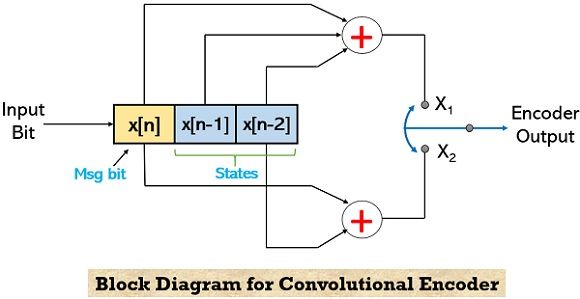
2.1 Encoder Structure A convolutionalcode introduces redundant bits into the data stream through the use of linear shift registers as shown in Figure 2.1.
 This state diagram shows the transition from one state to another of the encoder according to the input bit. In the above figure, the input bits 0 and 1 are represented by blue and red lines, respectively.